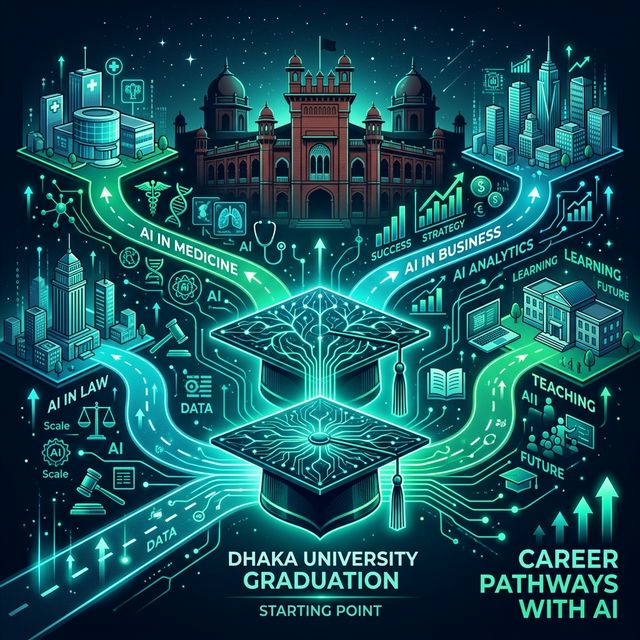
The final lecture looks forward. How is AI reshaping every career? What does it mean for DU graduates? You'll map your future, build a learning roadmap, and present ideas for how AI can solve real problems at the University of Dhaka.
💭
Concept Preview — 10 Min
💼 AI Is Changing Every Career
Law: AI can draft contracts, research case law, predict outcomes — but judgment, advocacy, and ethics remain human
Medicine: AI reads X-rays, suggests diagnoses, monitors patients — but empathy, complex decisions, and patient trust are human
Journalism: AI writes routine reports, transcribes interviews — but investigative reporting and source relationships are human
Teaching: AI personalizes learning, grades routine assessments — but mentoring, inspiration, and child development need humans
Business: AI forecasts trends, automates customer service — but strategy, leadership, and relationship-building are human
Social Work: AI helps identify at-risk populations — but counseling, community building, and advocacy require humans
🔄 Automate vs. Amplify
Jobs AI will automate: Data entry, routine translation, basic customer support, simple report writing, repetitive analysis
Jobs AI will amplify: Creative direction, strategic thinking, complex negotiation, research design, community leadership, counseling
The pattern: Tasks that are routine, repetitive, and rule-based → automated. Tasks requiring judgment, creativity, empathy, and context → amplified
For DU graduates: The question isn't "Will AI take my job?" — it's "How will AI change the tasks within my job?"
💭
1. Concept
🛠️
2. Hands-On
🗺️
3. Takeaway
Concept Discussion — 20 Min
Cognitive Restructuring of Labor Markets
According to structural economic analyses, AI will not simply act as labor replacement; it forces task-level cognitive restructuring. Every profession represented by Dhaka University graduates will undergo an automation paradigm shift, reallocating human capital toward abstract problem-solving.
44%
Of workers' core skills are expected to change in the next 5 years (WEF, 2023)
#1
Most important skill for 2025: Analytical thinking, followed by Creative thinking
"AI won't replace you. A person using AI will replace you."
— Widely cited industry axiom
AI in Your Specific Faculty
No field is exempt. How will AI act as a co-pilot across Dhaka University graduates' future careers?
Law & Policy: AI indexing 10,000 court precedents in seconds vs. hallucinating fake case laws.
Medicine & Biology: AlphaFold solving the 50-year-old protein folding problem, accelerating drug discovery in Bangladesh.
Arts & Humanities: Analyzing linguistic patterns across thousands of historical texts to find new cultural insights.
The Half-Life of Learned Skills
The "half-life of a learned skill" is the time it takes for a skill to become half as valuable. In 1980, a technical skill lasted 30 years. Today, it lasts less than 5 years.
The Takeaway: Rote memorization of facts is obsolete. The most critical meta-skill for a Dhaka University graduate is continuous architectural adaptation—learning how to learn, and learning how to integrate new AI toolings into your workflow immediately as they are released.
The Paradigm of the "T-Shaped Professional"
The highest-paid professionals of the next decade will be "T-Shaped".
The Vertical Bar (Deep Domain Expertise): Your rigorous university education. Economics, Law, Literature, or Physics. AI cannot replace this deep contextual understanding.
The Horizontal Bar (Broad AI Literacy): The ability to use AI tools (Prompt Engineering, Data Analysis) horizontally across any problem in your domain.
Bangladesh National AI Strategy (2024-2029)
The government recently drafted a comprehensive AI strategy to transition from "Digital Bangladesh" to "Smart Bangladesh".
Key Pillars:
The strategy focuses on building local dataset infrastructure, upskilling youth, creating a Bangla foundational model, and deploying AI in agriculture, education, and healthcare while establishing legal frameworks for data protection.
Your Role: As non-CS graduates, you are needed to guide the application of this strategy. You are the domain experts who must ensure AI solves actual local problems, rather than just copying Western tech trends.
Hands-On Activity — 20 Min
🗺️ Activity 1: The Career Red-Teaming
Enter the job title you hope to hold in 5 years into ChatGPT/Gemini.
Act as an expert in workforce automation. Which 3 specific tasks in my future job will be fully automated by AI?
Which 3 specific tasks in my job will become purely human, soft-skill, or high-judgment tasks?
Discuss the results with your group. Did the AI guess your future correctly?
🗺️ Activity 2: Personal AI Learning Roadmap
Build a 3-month plan to continue your AI learning using free tools:
Month 1: Complete one free online course (Elements of AI or Google AI Essentials)
Month 2: Use AI daily in your academic work with the prompt templates from Lecture 2
Month 3: Teach one peer or family member about AI literacy — teaching is the best learning
Write this down as a concrete plan with dates and checkpoints
🎤 Activity 3: Final Showcase
Each group presents one idea for how AI could solve a real problem at the University of Dhaka:
Examples: AI-powered course scheduling, AI tutoring for first-year students, chatbot for administrative questions, AI-assisted library search in Bangla
Format: 5-minute presentation covering the problem, proposed AI solution, potential risks, and implementation steps
Class votes on the most innovative and most practical ideas
Winning ideas could be pitched to DU administration!
🎓
Your Takeaway: AI Readiness Portfolio
Collect all 5 deliverables from the entire lecture series into your final portfolio:
📁 Your Complete Portfolio
Lecture 1: AI Trust Map — tasks you would/wouldn't trust AI with
Lecture 2: Prompt Toolkit — 10 reusable prompt templates for your subject
Lecture 3: Creative Mini-Portfolio — one AI-assisted writing + one visual
Lecture 4: AI Ethics Position Paper — one-page paper on a Bangladesh AI issue
Lecture 5: Career AI Audit + 3-Month Learning Roadmap